Helical foundations · new construction
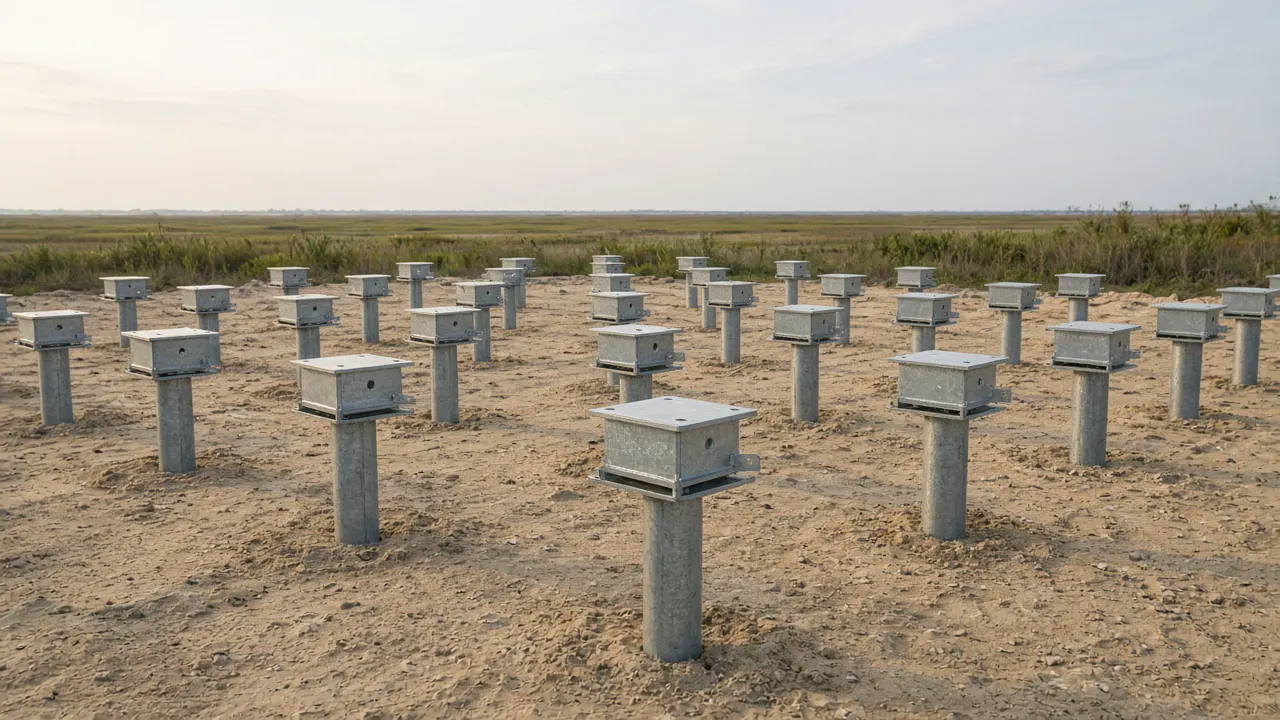
Steel piles before the house goes up.
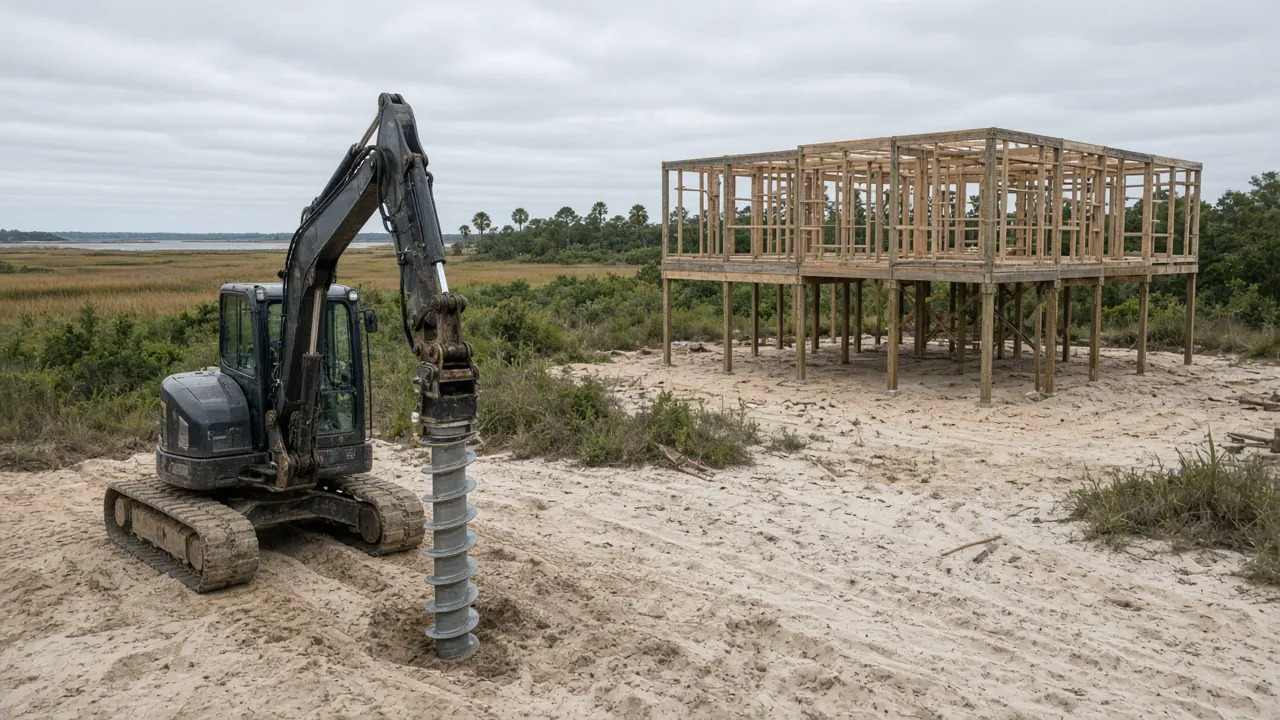
TrueLine installs open-ground helical foundations for custom homes on soft coastal pads, flood-zone lots, and raised-floor builds within about 100 miles of North Myrtle Beach.
Benefits
Why builders specify helicals on coastal pads.
Soft coastal and marsh soils
Reach a deeper bearing layer under loose sand, fill, and organics common along the Grand Strand and Lowcountry.
Flood zones and raised floors
Detail for compression, uplift, and lateral load when the home is elevated or mapped in a flood zone.
No concrete cure wait on the pile
Steel piles are ready for the footing or grade-beam connection once installed and accepted — the pile itself does not cure.
Quick open-ground install
A typical new-home array often installs in a day, depending on pile count, depth, access, and weather. Bid the job you have.
Torque-verified capacity log
Installation torque is recorded per pier for the engineer of record to review against the design correlation.
Hot-dip galvanized (ASTM A123)
Coastal corrosion protection by hot-dip galvanizing unless the engineer specifies another coating or section.
Minimal site disturbance
Rotation advances the pile with little spoil — useful on finished landscaping plans and soft, wet pads.
Works on tight lots
Compact equipment fits many residential sites where large excavators or open shafts are impractical.
Where it's used
Custom homes first. Coastal conditions in mind.
custom-homes
Custom homes on soft coastal soils
Helical piles installed on open ground before the house is built — for pads that need deeper bearing than a shallow footing.
On Grand Strand and Lowcountry lots, loose sand, fill, and soft organics often sit above a firmer layer. Helical piles are rotated to the engineer’s stop criteria, capped, and ready for footings or grade beams. There is no concrete cure wait on the pile itself. Depth and capacity follow the geotech and the engineer of record — not a county-wide rule.
flood-elevated
Flood zones and elevated / raised-floor homes
Uplift and lateral demands matter as much as compression when a home is raised or sits in a mapped flood zone.
Coastal flood zones and raised-floor designs often call for tension and lateral capacity as well as compression. Helical piles can be detailed plumb or battered per the engineer. Hot-dip galvanizing (ASTM A123) is the coastal default we plan around unless the engineer specifies otherwise. Flood-zone designation and connection details still come from the survey and the structural drawings.
tight-lots
Tight lots and minimal site disturbance
Compact equipment and little spoil — useful on marsh-edge and infill lots where a large open excavation is hard.
Helical installation typically leaves less spoil than a drilled shaft and does not need a large open hole that can collapse in wet sand. Compact carriers can work many residential lots. Gates, trees, setbacks, and tides still control access — we confirm that before mobilization.
engineer-coordination
Plan review and engineer coordination
We work from your plans and geotech, coordinate pile layout with the engineer of record, and hand back torque logs and an as-built.
TrueLine reviews the structural plans and any geotechnical report, proposes a pile layout for the engineer of record, and installs to that design. Each pier’s torque is recorded. Closeout includes the as-built layout and torque log for the engineer and inspector. We do not replace the engineer of record.
Process
Plans to as-built.
Plans and geotech
Share structural plans and any geotechnical report. We review reactions, flood zone notes, and access. A visit is not a design and not a substitute for the engineer of record.
Layout and quote
We coordinate a pile layout with the engineer of record and provide a fixed-price proposal for installation. Torque targets and stop criteria belong to that design.
Install and torque logs
A hydraulic drive head rotates each pile. Depth and torque are recorded. Caps or brackets are set as designed. Weather, tides, and obstructions can change the schedule.
As-built for engineer and inspector
You receive an as-built pile plan and torque log to hand to the engineer of record and the inspector. Sign-off remains with those parties.
FAQ
Foundation questions, limits left visible.
What is a helical pile for new construction?
A helical pile (also called a helical pier or screw pile) is a steel shaft with one or more helical plates. It is rotated into the ground on open pads before the house is built, then capped for a footing, grade beam, or elevated frame. TrueLine focuses on this new-construction work for custom homes along the coast.
Are the piles hammered in?
No. They are advanced by rotation. Nothing on this site means every pile is vertical — a design can call for plumb piles, battered piles, or both.
Why use helicals on coastal lots?
Loose sands, soft organics, high groundwater, storm scour, and salt exposure show up often on Grand Strand and Lowcountry sites. Helical piles can reach a deeper layer with little spoil. They do not erase those conditions. Corrosion, scour, uplift, and lateral load are still the engineer’s checks.
Does torque prove capacity?
Torque is measured while the pile rotates and is written down. It can be correlated to capacity only when the engineer accepts that correlation for the shaft, helices, and soil. A reading is not a substitute for the design.
What about galvanizing?
For coastal exposure we plan around hot-dip galvanizing to ASTM A123 unless the engineer of record specifies another coating or steel section. Coating and thickness remain a project specification.
Do you do foundation repair?
TrueLine’s focus is new-construction helical foundations installed before the house is built. If you need repair or underpinning on an existing home, ask and we can point you to options — but new builds for custom homes are the work we are set up to quote.
How does this compare with concrete piers?
A concrete pier is cast and must cure. A steel helical pile is rotated, usually with less spoil, and the steel section does not wait on a cure. Which system belongs on a site is an engineering choice.
Are they accepted for coastal permits?
Building officials in South Carolina and North Carolina see helical products regularly. A current evaluation report (ICC-ES or IAPMO) is one document a reviewer may ask for. We do not invent a report number here — ask for the current report on the product specified for your job. A report is not a permit and not a flood-insurance decision.
What will it cost?
No price list is published here. Cost moves with pile count, depth, helix layout, shaft, galvanizing, access, mobilization, engineering, geotech, and permitting. Request a quote with your plans for a fixed-price proposal.
Where do you work?
Within about 100 miles of North Myrtle Beach: Horry and Georgetown Counties and the Charleston area in South Carolina, and Brunswick and New Hanover Counties in North Carolina, with nearby coastal communities by confirmation. Call or email to confirm a specific lot.
Who designs the piles?
The engineer of record designs the foundation. We coordinate layout, install to the design, and return torque logs and an as-built. License numbers and engineer names are not listed on this site.